

Building Inner Strength – Especially When It Gets Cold: Through Warmth
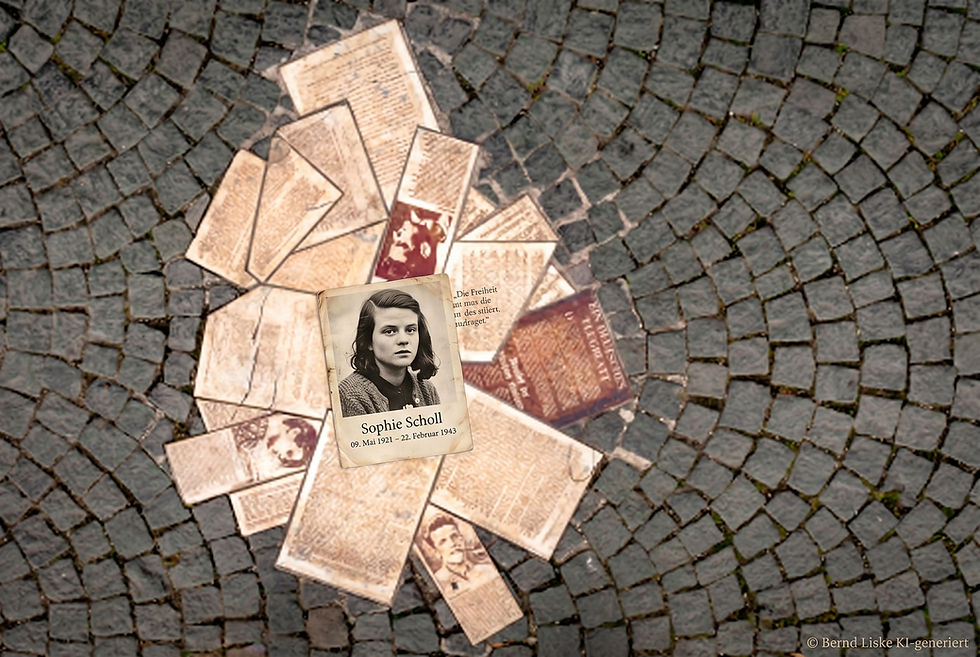
Sophie Scholl on the 105th Anniversary of Her Birth: Civil Courage as a Way to Counter Indifference and Managed Convictions
JEvery era has its own challenges.
You have to recognize them and face them.
There is a kind of cold that we enjoy and that strengthens us. It awakens us. A cold morning, a long walk, that first step outside: the body tenses, breathes more deeply, and wakes up. It is well established that exercise and moderate physical activity can promote health and resilience. Cold showers also activate the body, increase alertness, and strengthen the immune system. We expose ourselves to this cold – we actively engage with it – because we know its positive effects.
There is, however, a second kind of cold that is much harder for us to face. It is social. It arises when people treat one another as a risk – as a disturbance, as a misplaced sense of belonging, as a moral problem. It arises when engagement is no longer seen as a prerequisite for understanding, but as an imposition. When the conversation with one another – which makes us citizens – is replaced by silence – or by talking about others instead of talking with them. It is the coldness I describe in my essay The Managed Human: a society of indifference that accepts rather than examines, that avoids rather than engages.
What if we were to expose ourselves to this coldness as well: as a form of training to strengthen our defenses? What if we counter the coldness of fear, simplification, and complacent conformity with our warmth, our stance, our steadfastness – thereby influencing the social climate? What if we intervene: in what we recognize as wrong, in what will surely come back to haunt us – and even more so our children and grandchildren? What if we criticize with the awareness that we want the best for the other person, the group, or society? Criticism is one of the most valuable forms of service. It requires respect and empathy, for it helps us improve and avoid mistakes. If we do that too, if we do it when it’s hard, if we do it when others back down: What would that do to us?
May 9 marks the 105th anniversary of Sophie Scholl’s birthday. As is customary on such commemorative days, there will again be many empty words: heard, accepted – and forgotten the next day. But this day can be more than a ritual. It is an opportunity to ask questions anew: How does conformity become confrontation? How does silence become dissent? How does acceptance become discernment? And how do we conduct this confrontation in a way that does not divide us: For we are a people who have a future only together.
Sophie Scholl and the White Rose are not significant because they were perfect. They are significant because, in an environment of radical oppression, they decided to no longer remain silent. They acted at a time when dissent was life-threatening. The White Rose was not a symbol, but a circle of people in Munich during the war years: Sophie and Hans Scholl, Alexander Schmorell, Christoph Probst, Willi Graf, Professor Kurt Huber, and others. They read. They discussed. And at some point, that was no longer enough for them. In 1942–43, they wrote and distributed six leaflets against the Nazi dictatorship. While distributing the sixth, Sophie and Hans Scholl were arrested.
One can know these facts – and yet have understood nothing. For what matters is not only what happened, but what it meant to do it – and to do it at that time. Their actions cannot be explained without situating them in the era in which they took place. And one cannot learn from these actions today without taking into account the progress of civilization. Every era has its own challenges: We must recognize them – and face them.
There is no doubt that systemic parallels exist. Anyone looking back at the period beginning in 1933 recognizes not only political radicalization but also a shift in thinking: reality was simplified, contradiction delegitimized, and unambiguity demanded. Debate gave way to categorization, and differentiation to decision-making. Comparable developments can also be observed in the so-called “Zeitenwende”. The renewed effort to heighten tensions in security policy requires a simplified way of thinking that no longer questions political decisions. Complexity becomes a burden, differentiation an imposition. In their place come shortcuts: friend or foe. Right or wrong. No alternative.
In this process, patterns of interpretation take hold that are intended to provide political guidance but, in doing so, narrow the space for divergent perspectives. Enemy stereotypes are in vogue. They are emotionally charged, they structure perception, they organize reality, and they provide apparent clarity. What serves to legitimize political, military, and other actions simultaneously has a paralyzing effect on a society that grows accustomed to this form of orientation. Such actions demand not debate but classification, not scrutiny but acceptance. The problem is not the enemy stereotype itself, but the mindset that is satisfied with it. For this mindset loses the ability to distinguish between reality and interpretation. It accepts the order that is offered – and regards it as insight.
The consequences are grave. Those who conform and accept no longer need to think. Indifference becomes the currency even in the so-called “Zeitenwende”: The greater the intellectual alignment with prescribed objectives, the lesser the inner resistance. Freedom is not understood as a space for thought, but is a purchased freedom: it promises belonging and social stability through the adoption of required attitudes.
The Holy Roman Empire used to stab and crucify people.
In the Middle Ages, people were hanged and burned.
In the 20th century, people were shot and gassed.
In democracy, people are ignored and frozen out.
Such conformity requires no explicit instruction. It arises through repetition, through expectation, through the unspoken understanding of what is considered acceptable to say. It arises from what is no longer said. From what is no longer asked. From what one no longer allows oneself to think. It is precisely in this that its effectiveness lies. For it makes it harder to tear away the cloak of indifference: not because resistance would be impossible, but because the conditions for independent thought are being insidiously eroded.
And yet there is a relevant civilizational advance. Anyone who expresses an opinion in Germany today does not, as a rule, risk their life. Anyone who publicly criticized the terror regime or called for resistance in 1943 acted against an order that did not engage in debate, but countered it with arrest, interrogation, show trials, and death sentences. The practice of evading debate has not disappeared. It has changed. It has become less visible, less tangible, but no less effective.
Repression rarely occurs openly today. It operates not primarily through violence, but through structure. Through classification, through social sanctioning, through the shifting of what appears permissible to say. It is not the prohibition that takes center stage, but the climate. Dissent is not necessarily suppressed – but it is made more difficult. It costs one’s reputation, one’s ability to connect, one’s sense of belonging. It demands more strength than simply going along with the flow. Thus a different form of conformity emerges – no longer enforced by immediate threat, but fostered by habituation, convenience, and the silent workings of social mechanisms. And from this conformity grows a force stronger than any overt repression: indifference.
The opposite of love is not hate, it's indifference.
The opposite of art is not ugliness, it's indifference.
The opposite of faith is not heresy, it's indifference.
And the opposite of life is not death, it's indifference.
Because of indifference, one dies before one actually dies.
Elie Wiesel (1928 – 2016) Writer, Nobel Peace Prize laureate, Holocaust survivor
Indifference is the most stable form of domination. It requires no violence, no threats, no persuasion. It is self-sufficient. It ensures that what ought to be said is not said. That what could be thought is not thought. That what might be possible no longer appears as a possibility. But this form of rule comes at a price: indifference spreads through society like a virus and makes it sick.
That is why the misinterpretation of defensibility is one of the greatest dangers of our time. Resilience is reduced to armament, to enemy stereotypes, to strength. But a democracy is not defensibility by shutting itself off, but by standing firm from within. Defensibility does not arise from weapons, but from judgment – not from the opponent, but from how we deal with them. A democracy defends itself not through harshness, but through its capacity for nuanced debate. And to do so, it must tear away the cloak of indifference.
The power of good does not unfold
through the means of evil.
Even what presents itself as an alternative misses the mark. Anyone who thinks they can distinguish themselves by using the same methods as those they criticize only exacerbates the problem they claim to be solving. Fighting fire with fire only helps the fire spread. An alternative does not arise from new enemy stereotypes, but from an approach characterized by respect, truth, a willingness to engage in dialogue, and the search for common ground – not least shared goals. Not by fighting the opponent, but by winning over the other side.
This is precisely where the challenge of our time lies. For a society that is no longer openly forced into silence can still lose the ability to speak. “Tear away the cloak of indifference you have wrapped around your hearts!” as the White Rose demanded, is not enough – then or now. For the willingness to tear away the cloak also requires grappling with the question of how this is to be accomplished. The leaflets offer no clear answer to this. They call for separation, for action, for a break. Yet they do not show how this rupture is to be carried out in detail. They point to courage – but not to the method. If back then the only option was to fight fire with fire, that is no solution today. Every era must develop its own form of engagement.
Today, hardening does not mean arming oneself against violence, but against inner erosion. Against the comfort of conforming. Against the temptation to avoid complexity. Against the tendency to relinquish thought. Indifference cannot be fought with indifference. It demands warmth: the warmth of respect, of attention, of serious engagement. It demands a willingness to encounter the other as a human being – and not as a function, not as an adversary, not as a problem. Civilizational progress is evident not only in the fact that we are allowed to do more – but in the fact that we handle this freedom better.
By engaging in dialogue, I combat my own indifference. Not just on a grand scale, but already on a small scale: in the family, at work, in everyday life, in conversation. That is where it is decided whether a society is capable of correcting itself. Only a comprehensive engagement is capable of breaking up the hardened ground of indifference and creating the conditions for new thinking to emerge – and with it, new action.
Sophie Scholl rose above the indifference of her time, yet she could not defeat it or limit its consequences. By becoming aware of the means at our disposal and applying them to act more effectively and work toward a society united by common values, we can honor her memory – and hope that our country does not face a similar fate again.
There is no crime, no trick, no ignorance, no complacency, no stupidity,
no ruse, no deception, no fraud, no vice that should be spared from scrutiny and exposure.
Meet their lack of respect with respect; expose their silence as cowardice, their logic as deceitful, their speeches as serving their own interests rather than the common good, their scheming instead of their integrity – but do not ridicule them in full view of everyone, for we are a people who have a future only together: Do not lower yourselves to their level, but change yourselves through engaging with them. And sooner or later, public opinion will recognize the value. Confrontation and truth alone are probably not enough – but they are the only means without which all others fail.


